
MSME Briefing Bureau
Leadership Mantra- Episode-5
Malik-Manager ya HR?
Annual appraisals measure performance, but do they recognise leadership crisis?!
Most organisations take great pride in their annual appraisal systems. They are presented as scientific, objective and data-driven mechanisms designed to identify high performers and future leaders.
Yet, an appraisal system is not very different from a balance sheet. It captures numbers, ratings and targets achieved. What it rarely captures are qualities such as judgment, emotional intelligence, initiative, resilience, teamwork, empathy and the ability to lead during moments of uncertainty.
Ironically, the blanks in these “scientific” matrices are ultimately filled by human beings—team leaders, reporting managers and HR professionals. And human judgment, by its very nature, is not always free from bias, assumptions or limited perspectives.
The larger question is this: Can one appraisal matrix truly evaluate employees working in vastly different environments? Can the same yardstick be applied to a sales executive, a legal officer, a plant supervisor and a software engineer?
Perhaps the challenge is not the existence of appraisal systems. The challenge lies in assuming that a single framework can adequately measure every dimension of human capability.
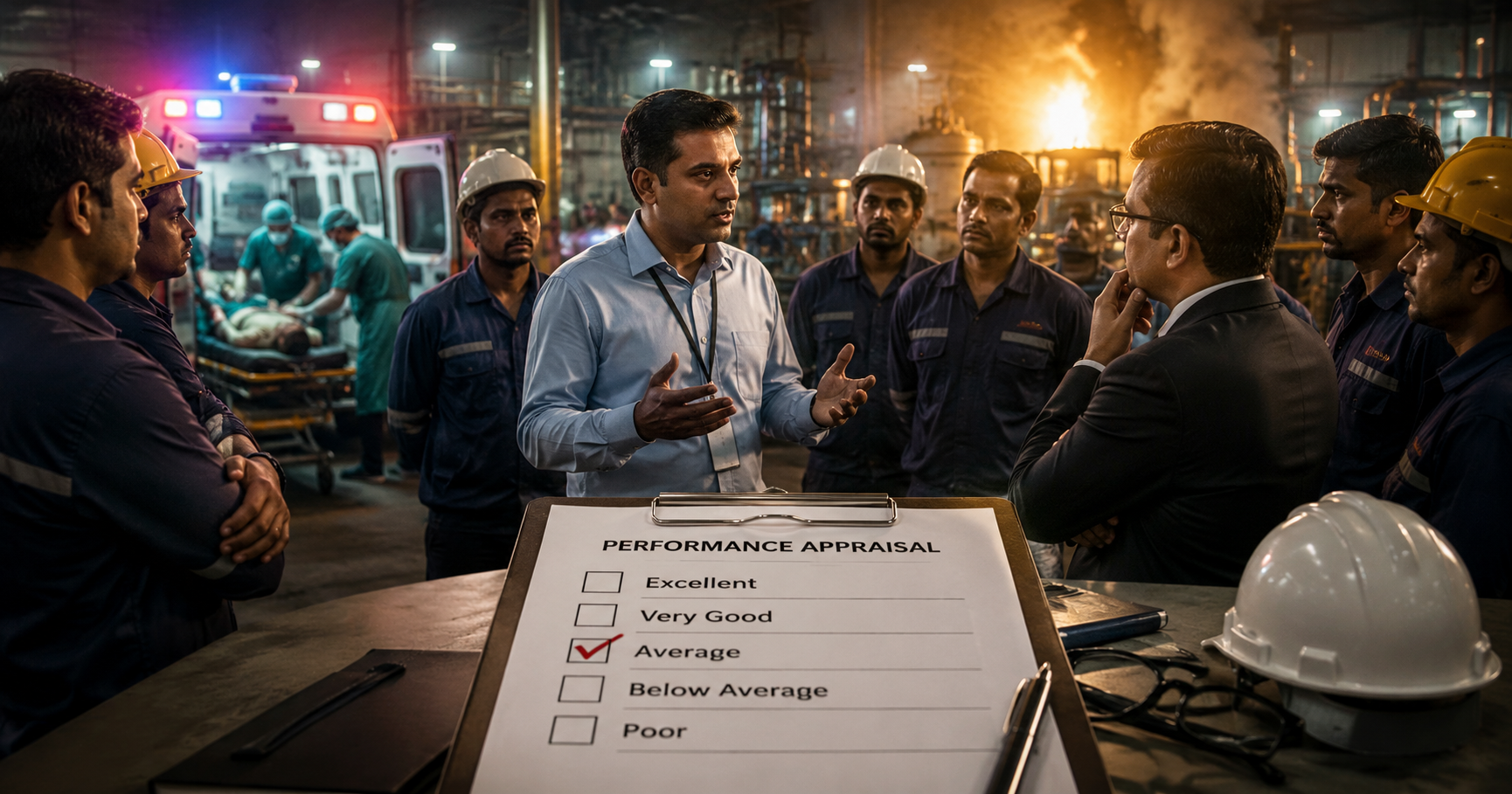
Consider the case of Subash, a Legal and Labour Officer employed with a chemical company.
One night, a boiler explosion at the factory resulted in the death of two workers and left four others with severe burn injuries. Within hours, Subash reached the plant, coordinated medical assistance for the injured, ensured procedural compliance for the deceased, and worked closely with the authorities.
The following morning, emotions ran high. Workers, angered by the incident, refused to report for duty. Production was at risk. Industrial relations stood on the brink of collapse.
Subash spent over an hour speaking to the workers, listening to their concerns and reassuring them that due process would be followed. Gradually, the situation de-escalated. Employees returned to work, production resumed, and the company avoided a prolonged labour dispute at a time when stability was critical.
Now ask yourself:
Under which column of an appraisal form do we record crisis leadership?
Which competency box captures the ability to prevent organisational paralysis?
What rating should be assigned to someone who protects industrial harmony when the entire system is under stress?
Yet, when the annual appraisal cycle arrived, Subash was rated as an “average employee.”
Perhaps his targets were not extraordinary. Perhaps he did not submit the most impressive presentations or maintain the neatest dashboards. But when the organisation faced one of its most difficult nights, he did what leaders do—he showed up, took responsibility and delivered results when they mattered most.
This is where the conversation moves beyond appraisals.
The Malik asks, “Did the business continue to operate?”
The Manager asks, “Did my team deliver?”
HR asks, “Did the employee meet the defined competencies?”
Leadership asks a different question altogether:
“Who stood up when the organisation needed them the most?”
Leadership rarely announces itself through annual reviews or quarterly scorecards. It reveals itself in ordinary people responding to extraordinary circumstances.
As Indian enterprises prepare for the future, they will invest in technology, automation and artificial intelligence. Yet, their long-term success will continue to depend on something far less predictable—the ability to recognise and nurture human potential.
Because the future leader of your organisation may not always be the employee with the highest rating.
He may simply be the person who quietly stepped forward when everyone else stepped back.
And that brings us to the question:
Malik, Manager ya HR—who truly owns the responsibility of recognising human potential?
Leadership Mantra
“Performance is measured in reports. Leadership is revealed in moments of crisis.”





Leave a Reply