
MSME Briefing Bureau
Energy, supply chains and sea lanes now define India’s strategic resilience
The Strategic Lens
Every geopolitical event eventually reaches the factory floor. A disruption in a distant shipping lane, a change in energy markets, a new trade corridor or a strategic partnership between nations ultimately influences raw material costs, logistics, exports, financing and business competitiveness. At MSMEBriefing.com, we look beyond the headlines to explain what happened, why it matters strategically, how it will affect Indian businesses, and what entrepreneurs should do next. Because in today’s interconnected world, understanding geopolitics is no longer optional—it is becoming a business advantage.
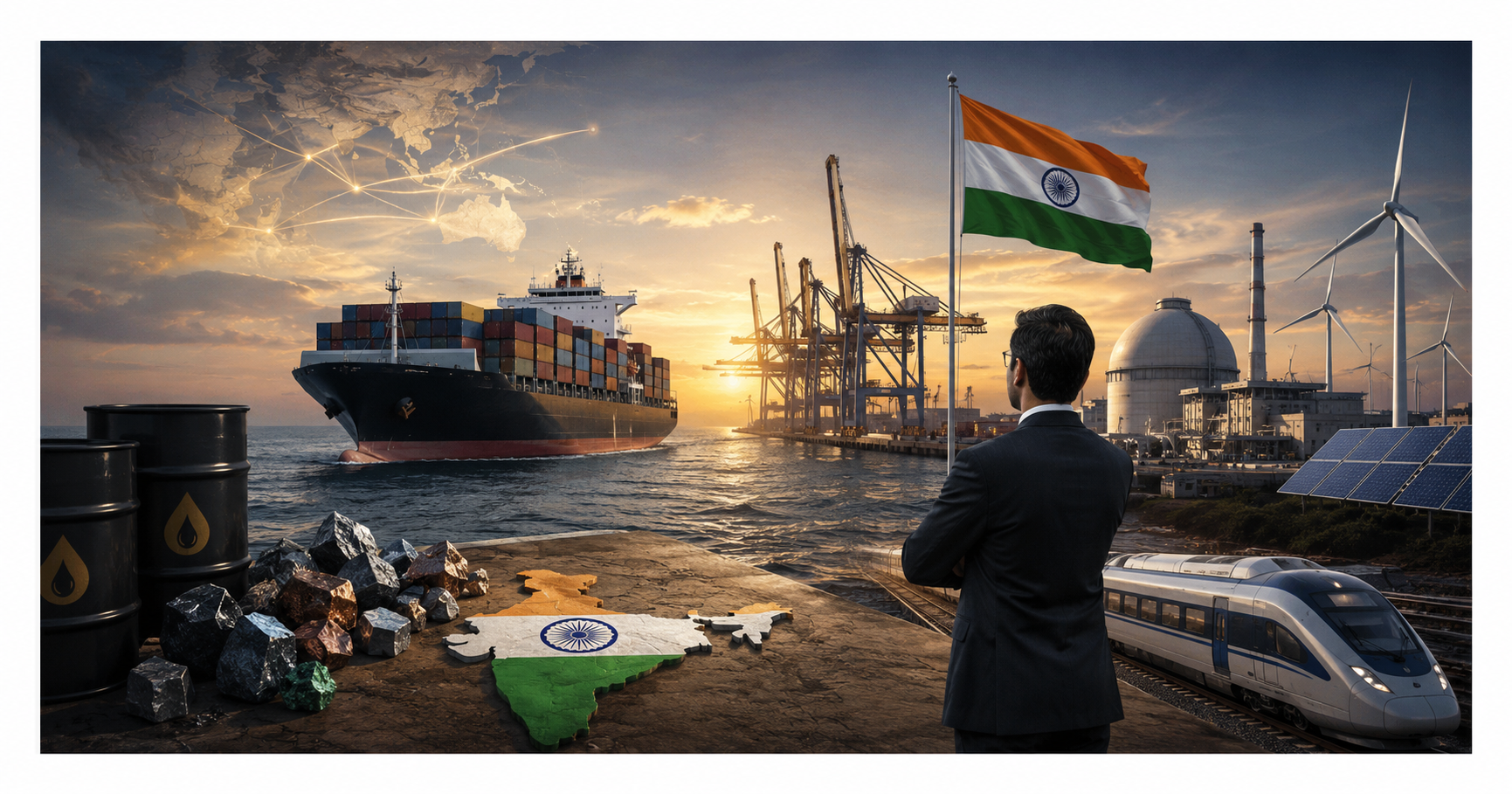
The closure of the Strait of Hormuz earlier this year was more than another geopolitical flashpoint. It became a defining moment in India’s strategic thinking. For decades, national security was measured by military strength and territorial defence. Today, it is increasingly determined by uninterrupted energy supplies, resilient shipping routes, critical minerals, trusted technologies and diversified supply chains. India’s recent policy decisions suggest that New Delhi is quietly constructing a new strategic architecture—one designed not merely to deter conflict, but to ensure that no single disruption can derail the country’s economic rise.
The Real Story Is Bigger Than Hormuz
News headlines often isolate events. One day it is the disruption in the Strait of Hormuz. A few months later it is an agreement on Sabang Port in Indonesia. Then comes the first criticality of India’s Prototype Fast Breeder Reactor (PFBR) at Kalpakkam, followed by long-term uranium procurement agreements and fresh partnerships on critical minerals.
Viewed independently, these appear to be unrelated policy announcements.
Viewed together, they reveal something far more significant.
India is gradually moving away from a national security model built around defending borders towards one that protects the systems sustaining economic growth. The emphasis is shifting from reacting to crises to building resilience against them.
In strategic terms, this represents the emergence of a doctrine based on strategic redundancy—ensuring that no single supplier, shipping lane, technology, resource or geopolitical relationship can become a critical point of national vulnerability.
Hormuz Was a Wake-Up Call, Not the Beginning
The disruption in the Strait of Hormuz exposed a reality that policymakers had anticipated for years.
India imports the overwhelming majority of its crude oil. Any disruption in one of the world’s most critical energy chokepoints inevitably affects domestic fuel prices, freight costs, inflation and industrial competitiveness.
The sharp rise in the Indian crude basket during the crisis demonstrated the economic cost of geopolitical instability. Yet it also highlighted the value of decisions taken years earlier.
Successive diversification of crude procurement towards Russia, the United States, West Africa and Fujairah meant India was no longer overwhelmingly dependent on a single maritime corridor. The country still absorbed a significant economic shock, but the disruption did not become an economic catastrophe.
That distinction is important.
Strategic resilience does not eliminate risk. It reduces dependence.
For India’s manufacturing sector—from chemicals and plastics to textiles, ceramics and engineering—the lesson is identical to good business practice: never depend on a single supplier when alternatives can be developed.
The Indian Ocean Has Become India’s New Strategic Frontier
If Hormuz represents India’s western vulnerability, the eastern Indian Ocean increasingly represents its strategic opportunity.
The recent agreement between India and Indonesia to jointly develop Sabang Port, located near the entrance to the Strait of Malacca, must be understood within this broader context.
Together with India’s planned Great Nicobar transshipment project, Sabang strengthens New Delhi’s strategic presence around one of the world’s busiest maritime corridors.
For decades, Chinese strategic thinkers have referred to their dependence on the Strait of Malacca as the “Malacca Dilemma”—the risk that excessive reliance on one maritime chokepoint could become a strategic liability.
India’s objective is different.
Rather than controlling sea lanes, New Delhi is steadily improving its ability to monitor, secure and diversify maritime access across the Indian Ocean Region. Sabang therefore complements—not replaces—India’s wider maritime network that stretches from the Andaman and Nicobar Command to logistics partnerships with friendly nations across the western and eastern Indian Ocean.
For exporters, shipping companies and manufacturers, secure sea lanes are not abstract strategic concepts. They determine freight costs, insurance premiums, delivery schedules and export competitiveness.
Critical Minerals Are the New Strategic Currency
The twentieth century was shaped by access to oil.
The twenty-first century will increasingly be shaped by access to critical minerals.
Nickel, lithium, cobalt, graphite and rare earth elements have become indispensable for electric vehicles, batteries, renewable energy systems, advanced electronics, aerospace and defence manufacturing.
Indonesia’s importance therefore extends far beyond maritime geography.
Its vast nickel reserves place it at the centre of the global energy transition.
India’s growing engagement with Indonesia reflects an understanding that future industrial competitiveness will depend not only on manufacturing capability but also on assured access to strategic raw materials.
In many respects, critical minerals are becoming what crude oil was to the previous century.
Energy Security Is Becoming Energy Sovereignty
India’s nuclear programme forms the second pillar of this evolving strategy.
The attainment of first criticality by the Prototype Fast Breeder Reactor at Kalpakkam marks a significant technological milestone in India’s long-term three-stage nuclear programme.
Its strategic importance lies not merely in electricity generation but in creating the foundation for a more self-reliant nuclear fuel cycle that ultimately seeks to utilise India’s vast thorium resources.
The journey, however, will be neither quick nor inexpensive.
The Government’s ambition of achieving 100 GW of nuclear power by 2047 demands unprecedented investment, technological capability, manufacturing expansion and regulatory capacity.
Likewise, diversified uranium procurement from multiple international partners should be viewed as a strategic bridge rather than a contradiction of self-reliance. Nations pursuing long-term autonomy often diversify before they become independent.
That is prudent strategy, not policy inconsistency.
National Security Now Includes Supply Chains
Perhaps the most profound shift in global geopolitics is that economic systems themselves have become instruments of national security.
Semiconductors, telecommunications equipment, artificial intelligence, digital infrastructure, shipping, financial systems and supply chains now influence geopolitical power almost as much as military capability.
India’s participation in initiatives such as the India–Middle East–Europe Economic Corridor (IMEC), its expanding partnerships with trusted technology economies and its efforts to strengthen domestic manufacturing all point towards one strategic objective: reducing excessive dependence on any single external ecosystem.
Strategic autonomy is no longer confined to foreign policy.
It increasingly extends to industrial policy.
Why Every MSME Should Pay Attention
Many business owners may ask a simple question.
Why should a factory in Morbi, a pharmaceutical unit in Ahmedabad, a textile processor in Surat or an engineering exporter in Rajkot be concerned about developments in Hormuz, Sabang or Kalpakkam?
The answer is straightforward.
Because geopolitics now shapes business economics.
Energy prices influence production costs.
Shipping disruptions affect delivery schedules.
Critical mineral shortages determine manufacturing capacity.
Supply-chain instability changes sourcing strategies.
Technology restrictions alter export opportunities.
In today’s interconnected economy, geopolitical risk has become a boardroom issue.
The companies that recognise these shifts early will enjoy greater resilience than those reacting only after disruption occurs.
What Business Leaders Should Watch
India’s emerging strategic architecture offers important signals for industry.
Business leaders should closely monitor:
- Implementation of the Sabang and Great Nicobar projects, as they could reshape regional logistics and maritime trade.
- Progress of IMEC, which has the potential to diversify export routes towards Europe.
- Global crude oil and shipping insurance trends, which directly affect industrial costs.
- India’s critical mineral partnerships, particularly in nickel, lithium and rare earth processing.
- Expansion of nuclear power capacity, which will influence long-term industrial energy security.
- Domestic semiconductor, electronics and advanced manufacturing investments, which will increasingly define India’s industrial competitiveness.
Companies aligning procurement, logistics and investment strategies with these structural trends will be better positioned to navigate an uncertain geopolitical environment.
The New Meaning of Strategic Autonomy
India’s recent initiatives should not be interpreted as isolated responses to successive international crises.
They represent the gradual construction of a broader strategic framework.
The objective is no longer simply to defend borders.
It is to ensure that no single sea lane, supplier, technology platform, commodity or geopolitical relationship can hold the Indian economy hostage.
This is the essence of strategic redundancy.
It recognises that sovereignty in the twenty-first century depends as much on uninterrupted flows of energy, minerals, technology, finance and trade as on military capability.
For policymakers, the challenge now shifts from announcing ambitious projects to executing them with discipline, speed and institutional capacity.
For Indian businesses, the message is equally clear.
Competitive advantage will increasingly belong to enterprises that diversify suppliers, strengthen logistics resilience, invest in technology and anticipate geopolitical change rather than merely respond to it.
If the twentieth century taught nations how to defend territory, the twenty-first is teaching them how to defend economic continuity.
India’s emerging strategic doctrine reflects that transformation. It is no longer preparing only for the wars that might be fought on its borders. It is preparing for the disruptions that could determine the nation’s prosperity long before a single shot is fired.




Leave a Reply