
MSME Business Strategy Desk
A family feud that reshaped FMCG, pricing, packaging and distribution forever.
History often remembers great products. Business remembers great strategies.
India’s shampoo revolution did not begin inside a multinational boardroom. It began with one family’s belief that ordinary Indians deserved affordable personal care. What followed was a fierce rivalry between two brothers that permanently changed retail pricing, packaging and distribution. Decades later, the same battle has returned with new players, new technology and far bigger financial muscle, offering timeless lessons for every MSME founder.
Executive Briefing
1. Why does this story matter?
Because it proves that market leadership is temporary. A challenger with sharper pricing, smarter distribution and deeper customer understanding can unsettle even the strongest market leader.
2. What has changed now?
The historic rivalry has entered a new phase. Reliance Consumer Products Ltd. (RCPL) has revived the Velvette brand, setting the stage for a fresh competitive battle with CavinKare, while also challenging multinational FMCG companies.
3. Who should read this?
MSME manufacturers, FMCG entrepreneurs, distributors, retail brands, packaging companies and every business competing against larger, better-funded rivals.
4. Why should MSMEs care?
Because this story demonstrates that innovation in pricing, packaging and distribution often creates a stronger competitive advantage than advertising budgets.
5. What decision should you reconsider today?
Ask yourself one question:
Are you selling products the way your customers earn money, or the way your finance department wants to sell them?
When One Idea Changed Indian Consumption
Every major business revolution begins with a simple observation.
During the 1970s, R. Chinni Krishnan, a schoolteacher from Tamil Nadu, believed shampoo should not remain a luxury reserved for affluent households. Millions of Indians simply could not afford to buy an entire bottle at one time.
His solution was remarkably simple.
Instead of reducing quality, reduce the quantity purchased per transaction.
Using a manually operated heat-sealing machine, he pioneered the liquid sachet, making premium products accessible to consumers with limited daily cash.
Few realised then that this innovation would permanently transform India’s FMCG industry.
Velvette Created an Entire Market
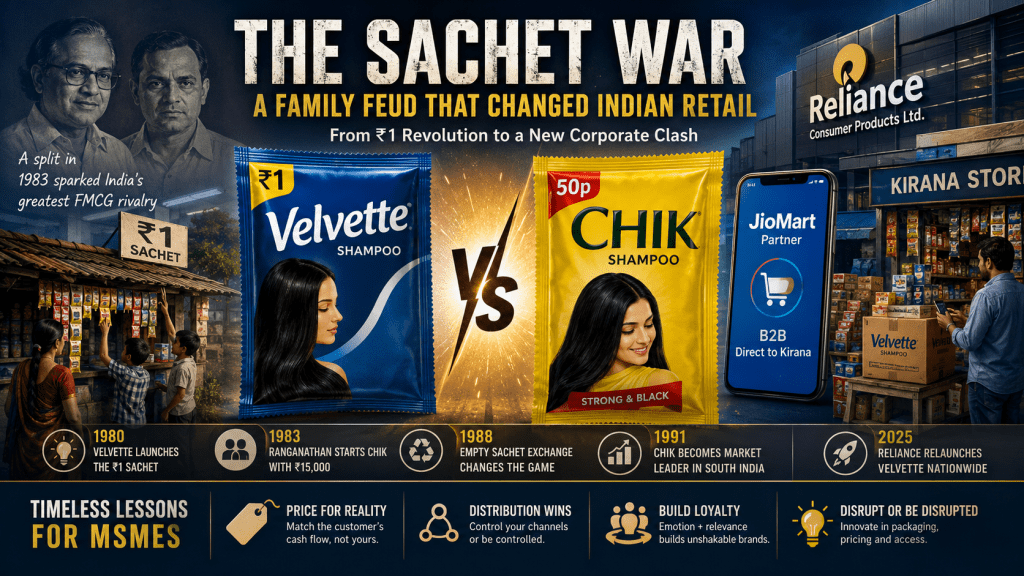
In 1980, Chinni Krishnan’s eldest son, Dr. C.K. Rajkumar, commercialised the idea through Sujatha Biotech by launching Velvette Shampoo.
Priced at ₹1 per sachet, Velvette perfectly matched the spending habits of rural consumers and daily wage earners.
Until then, shampoo was purchased occasionally.
Velvette made it an everyday product.
The company expanded rapidly across southern India and strengthened its reach through a significant distribution partnership with Godrej Soaps, helping establish one of the strongest retail networks of its time.
For several years, Velvette dominated the sachet market.
A Family Split Sparked India’s Greatest FMCG Rivalry
Success, however, did not guarantee stability.
In 1983, differences within the family resulted in a separation.
Rajkumar’s younger brother, C.K. Ranganathan, left the business with only ₹15,000 and established Chik India in Puducherry.
His mission was straightforward.
Defeat his brother’s company.
What followed remains one of India’s most remarkable competitive battles.
Three Moves That Changed Retail History
Ranganathan understood something that many businesses still overlook.
Consumers rarely change brands because of advertising alone.
They change when a competitor makes buying easier, cheaper or more rewarding.
He built Chik’s growth around three highly disruptive strategies.
1. Lower the Entry Price
Instead of matching Velvette’s ₹1 price, Chik launched sachets at 50 paise.
That single pricing decision opened an entirely new customer segment.
Millions who previously considered shampoo expensive suddenly became regular buyers.
2. Turn Your Competitor’s Success Against Them
In 1988, Chik introduced its now legendary Empty Sachet Exchange Scheme.
Consumers who returned five empty shampoo sachets received one Chik sachet free.
The brilliance lay in one detail.
Most empty sachets collected belonged to Velvette, then the market leader.
Children across villages collected discarded sachets, retailers promoted the campaign enthusiastically and Velvette’s physical visibility gradually disappeared from local markets.
It was low-cost marketing with extraordinary impact.
Today, marketers would call it behavioural disruption.
3. Speak the Customer’s Language
Instead of relying primarily on national advertising agencies, Chik invested heavily in regional cinema, local radio and regional celebrities.
Consumers did not merely recognise the brand.
They identified with it.
This emotional connection helped Chik build trust much faster than larger competitors.
The Industry Was Forced to Follow
By 1991, Chik had captured more than half of South India’s rural shampoo market.
Velvette entered a prolonged decline.
The impact extended far beyond one family business.
Large multinational companies, including Hindustan Unilever, accelerated their own sachet strategies because consumer behaviour had fundamentally changed.
The sachet was no longer an experiment.
It had become the industry’s dominant packaging format.
Later, Ranganathan renamed the company CavinKare Private Limited in 1998.
Rather than depending solely on shampoo, the company diversified into multiple businesses, including Green Trends salons, Cavin’s dairy products and other personal care categories.
This diversification reduced dependence on a single product and strengthened long-term resilience.
The Battle Has Returned—With New Players
Business history often repeats itself.
Only the names change.
Following the decline of Velvette and the passing of Dr. Rajkumar, the brand remained largely inactive for several years.
That changed in February 2025, when Reliance Consumer Products Ltd. (RCPL) acquired the perpetual brand licence and formulation rights for Velvette.
The acquisition revived one of India’s most recognisable legacy FMCG brands.
In October 2025, Reliance relaunched Velvette nationally.
This time, however, the battlefield looked very different.
Instead of depending entirely on conventional distributors, Reliance leveraged its JioMart Partner B2B platform, enabling faster supply to neighbourhood kirana stores while integrating the brand into its expanding retail ecosystem.
Velvette was also extended beyond shampoo into a broader personal care portfolio.
Meanwhile, CavinKare continued strengthening its rural leadership, supported by decades of brand loyalty and product formulations built around familiar consumer preferences.
The original family rivalry had evolved into a contest between one of India’s largest corporate groups and one of its most respected home-grown FMCG companies.
What Every MSME Should Learn
Many entrepreneurs believe bigger companies win because they spend more.
History says otherwise.
Velvette created a market.
Chik changed the rules of that market.
Reliance is now attempting to rewrite those rules again.
Across every stage, the winner was not necessarily the company with the biggest balance sheet.
It was the company that understood how customers bought, where they bought and what they could afford at that moment.
Those principles remain unchanged today.
Whether you manufacture engineering components, speciality chemicals, food products or consumer goods, your competitive advantage may not lie inside your factory.
It may lie inside your pricing architecture, distribution strategy or packaging design.
Final Thought
Every MSME founder should spend the next three days reflecting on one uncomfortable question.
If a competitor with one-tenth of your budget entered your market tomorrow, what unconventional strategy could they use to take away your customers?
If you cannot answer that question, your business may already be more vulnerable than your financial statements suggest.
The next market leader may not build a better product.
They may simply make your product easier to replace.

 MSME Briefing
Leave a comment