
MSME Leadership Mantra Desk
MALIK, MANAGER YA HR? – Episode 2
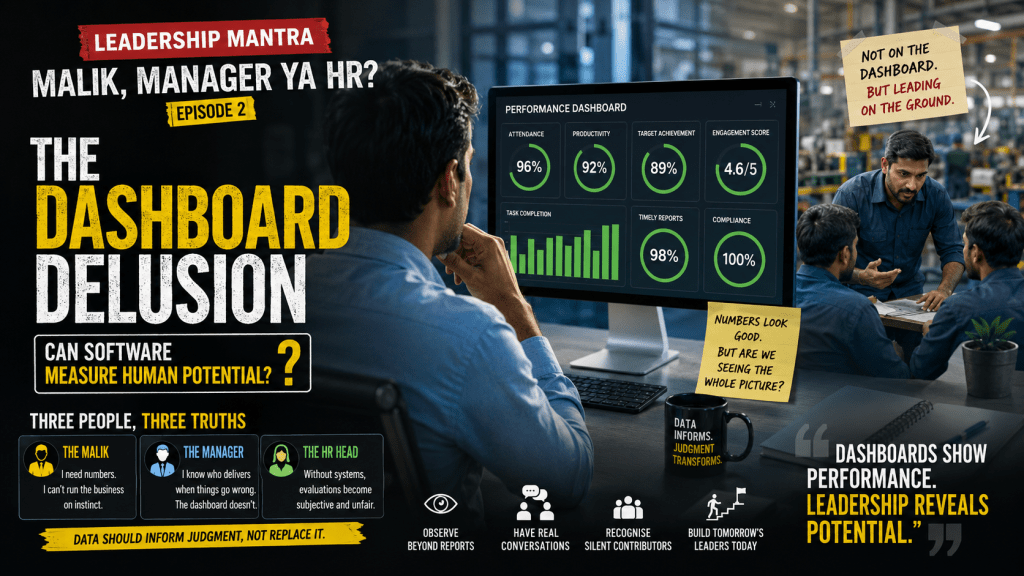
Can software measure human potential?
The owner of a mid-sized manufacturing company sat in his cabin reviewing the monthly performance dashboard. Productivity indicators were green. Attendance levels were stable. Employee engagement scores looked healthy.
Three months later, one of his most dependable managers resigned.
The dashboard never warned him.
Every dashboard creates an illusion: that whatever is measured matters and whatever cannot be measured does not.
As organisations increasingly adopt HRMS platforms, performance dashboards, pulse surveys and AI-driven employee analytics, leaders are gaining access to more data than ever before. Yet a fundamental question remains unanswered:
Can technology truly measure human potential?
The answer is both yes and no.
Technology can measure activity. It can track attendance, response time, task completion and survey participation. What it cannot easily measure are qualities that determine long-term organisational success—judgment, ownership, resilience, curiosity, influence and leadership potential.
And that is where many organisations make a costly mistake.
Three People, Three Truths
The debate often plays out between three stakeholders.
The Malik (Owner) wants numbers. He cannot manage hundreds of employees through instinct alone.
The Manager believes performance is best understood through observation, experience and day-to-day interaction.
The HR Head depends on systems and processes to ensure fairness, consistency and transparency.
All three perspectives are valid.
The problem begins when one replaces the other.
Data should inform judgment—not replace it.
The High Scorer Who Failed
A Rajkot-based engineering company supplying precision components to European customers introduced a sophisticated performance management system.
One production manager consistently topped the rankings. His reports were always updated, meetings were attended on time and every compliance requirement was meticulously recorded.
Then came a crisis.
A major overseas customer threatened to cancel an annual order worth nearly ₹10 crore because of a quality issue discovered just before shipment.
The dashboard star followed procedures. He escalated the matter, documented actions and waited for approvals.
Another manager, whose performance scores were merely average, took a different approach. He spent two days on the shop floor, coordinated production, quality and logistics teams, worked through the night and ensured the shipment met customer requirements.
The order was saved.
The dashboard had measured compliance.
It failed to measure ownership.
The Invisible Leader
A textile processing unit in Surat relied heavily on employee engagement surveys to identify future leaders.
One supervisor consistently remained invisible. He rarely participated in internal platforms and seldom appeared in engagement reports.
On paper, he looked disengaged.
Yet whenever a production line failed, a customer complaint surfaced or an urgent delivery had to be managed, workers sought him out first.
Not because he held authority.
Because he had influence.
A new plant head noticed this pattern during informal interactions. The supervisor was given responsibility for a critical customer account.
Within two years, he became one of the company’s most respected operational leaders.
The software never identified him.
A human leader did.
The Hidden Cost of Dashboard Leadership
When organisations confuse activity with capability, the consequences extend far beyond HR.
They may promote the wrong people.
They may overlook future leaders.
They may spend training budgets on visible performers while ignoring high-potential contributors.
They may lose talented employees who feel unseen.
The cost is not emotional.
The cost is commercial.
Poor leadership decisions eventually show up in productivity, innovation, customer retention and profitability.
What Dashboards Cannot See
Most HR software is not the problem.
The real problem begins when leaders use dashboards as a substitute for observation.
Data is easier than conversation.
Metrics are easier than mentorship.
Reports are easier than walking the shop floor.
Leadership potential often reveals itself during uncertainty, conflict, crisis and ambiguity—the very situations where software struggles to provide meaningful insight.
Before You Trust the Dashboard
Ask five questions:
- Who solves problems when nobody is watching?
- Who influences colleagues without formal authority?
- Who volunteers during difficult situations?
- Who learns beyond the requirements of the job?
- Who would the team naturally follow if the manager was absent?
If your dashboard cannot answer these questions, it is measuring performance—not potential.
The Leadership Mantra
Technology is a powerful tool. Organisations should continue using analytics, dashboards and surveys.
But leaders must remember that dashboards identify patterns.
People identify potential.
The future of an organisation will rarely be determined by employees who merely score highest on performance reports.
It will be shaped by those who step forward when the dashboard has no answer.
So ask yourself:
Are you using technology to understand your people—or to avoid understanding them?


 MSME Briefing
Leave a comment