
By Haresh B. Jhala:
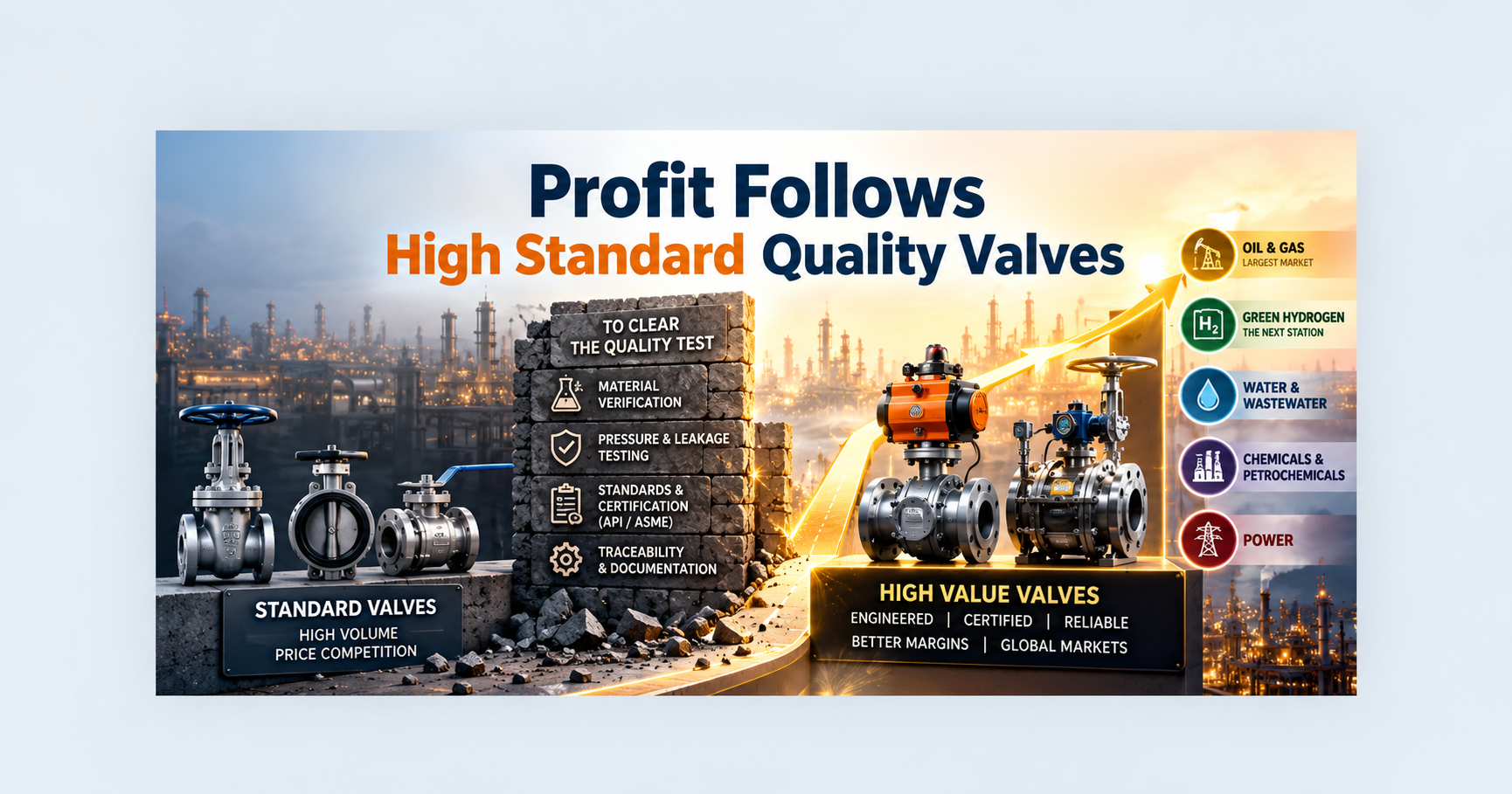
OIL & GAS IS THE BIGGEST MARKET.
GREEN HYDROGEN COULD BE THE NEXT STATION.
India’s industrial-valve industry is entering an interesting phase.
The market is growing. Demand is coming from oil & gas, refineries, petrochemicals, water infrastructure, power and increasingly automated industrial plants. New opportunities are also emerging around hydrogen and other energy-transition applications.
Yet many manufacturers — particularly MSMEs — face a contradictory reality.
The market can grow while the manufacturer’s margin shrinks.
That is because the real competition is no longer simply between one valve manufacturer and another.
It is between:
commodity and engineered products,
price and specification,
capacity and capability,
and manufacturing volume and customer qualification.
The Indian industrial-valve market was estimated at ₹12,948 crore (US$1.56 billion) in 2025. It is forecast to reach ₹13,861 crore (US$1.67 billion) in 2026 and approximately ₹19,422 crore (US$2.34 billion) by 2031, representing a 6.96% CAGR.
That implies approximately ₹6,474 crore (US$780 million) of additional market value between 2025 and 2031. Mordor Intelligence
So the question is not:
Will India need more industrial valves?
It almost certainly will.
The more important question for a valve manufacturer is:
Which valves — and which applications — will capture the profit?
The ₹6,500-crore opportunity is not one market
Industrial valves cover a wide range of products and applications.
Ball valves.
Butterfly valves.
Gate valves.
Globe valves.
Check valves.
Plug valves.
Control and actuated valves.
The economics are different for each.
According to the latest India industrial-valves market estimates, ball valves accounted for 25.17% of the market in 2025.
That implies a market of roughly ₹3,259 crore (US$393 million).
Quarter-turn valves — including ball, butterfly and plug valves — represented 39.80% of the market.
And the broader category covering other products, including control valves and actuators, is forecast to grow at approximately 7.25% CAGR through 2031. Mordor Intelligence
That tells us something important.
The opportunity is not necessarily to abandon conventional industrial valves.
It is to understand where conventional valves become higher-value products because the application becomes more demanding.
Oil & Gas: The Biggest Station
If the Indian industrial-valve market were a railway journey, oil & gas would still be its biggest station.
Oil & gas accounted for approximately 35.20% of India’s industrial-valve market in 2025.
On the 2025 market base, that translates into approximately:
₹4,558 crore (US$549 million)
This is a substantial industrial-valve opportunity.
And the demand is spread across the value chain:
- upstream oil & gas;
- pipelines;
- terminals;
- refineries;
- petrochemicals;
- city-gas distribution;
- storage;
- processing facilities.
The valve requirement changes with the application.
Ball valves are important where tight shut-off and automation are required.
Gate valves remain important for isolation duties.
Globe valves are used where throttling and flow regulation are required.
Check valves prevent reverse flow.
Control valves manage process conditions.
The important point is that the customer does not buy the same valve for every application.
The technical specification changes.
And that is where the economics start changing too.
Oil & Gas Is Not Just About Making a Valve
For a small manufacturer, entering oil & gas is not simply a question of adding capacity.
It is a question of becoming an approved and trusted supplier.
The buyer may require:
- specified materials;
- pressure classes;
- fire-safe performance;
- testing;
- traceability;
- documentation;
- quality systems;
- applicable API/ASME standards;
- type testing;
- inspection;
- delivery reliability.
API Specification 6D, for example, is specifically used for pipeline valves and defines manufacturing requirements for valves used in that environment. API has also updated the specification to address evolving requirements, including provisions related to hydrogen gas service. American Petroleum Institute
ASME B16.34 covers important requirements for specified valves, including pressure-temperature ratings, dimensions, materials, nondestructive examination, testing and marking. ASME
This creates an important barrier.
The question changes from:
“Can you make the valve?”
to:
“Can you prove that you can repeatedly make the valve to the required specification?”
That is a much more difficult question.
It is also potentially a much more profitable one for the manufacturer that can answer it.
The Hidden Business: Testing and Traceability
Many MSMEs think of testing as a cost.
The better way to see it is as a market-access investment.
A customer buying a low-cost standard valve may mainly compare price.
A refinery, pipeline operator, EPC contractor or chemical plant may ask much more difficult questions:
What material did you use?
Can you prove it?
How was it tested?
What pressure did it withstand?
What is the leakage performance?
Can you trace the material heat?
Can you reproduce the same quality in the next batch?
This is why testing, inspection and documentation can become commercially important.
The valve body may be made of metal.
But the qualification around the valve is part of the product’s value.
The China Challenge Is More Complicated Than “Cheap Imports”
The original research correctly identified China as a major competitive issue, but the story needs to be broader than simply saying Chinese valves are cheaper.
China is simultaneously:
pressuring the lower end of the market
while
moving up the technology ladder.
That creates a difficult environment for Indian MSMEs.
At the lower end, manufacturers face price competition.
At the higher end, Chinese manufacturers are increasingly developing capabilities in sophisticated applications.
The result is a squeeze from both directions.
For an Indian manufacturer, therefore, the strategic response cannot simply be:
“We will compete with China on price.”
That is unlikely to be a sustainable strategy for most MSMEs.
The more defensible route is:
specialisation + qualification + faster delivery + application knowledge + service.
This is also where the China+1 opportunity becomes relevant.
A global customer seeking supply-chain diversification may not be looking for the cheapest valve in the world.
It may be looking for a second reliable source.
That creates a different opportunity for Indian manufacturers.
The Export Myth: “Let’s Just Export”
Export is attractive.
But export is not a strategy by itself.
The original research was right to identify certification and qualification as barriers.
An industrial-valve manufacturer entering overseas markets may encounter requirements relating to:
- product standards;
- pressure equipment regulations;
- hazardous-area requirements;
- quality systems;
- third-party inspection;
- material traceability;
- testing;
- customer approval.
The investment is therefore not simply:
make valve → find foreign buyer → export.
It can be:
select application → meet specification → establish testing → qualify product → qualify company → obtain customer approval → build references → export.
That can take time.
And the manufacturer must carry working capital while the market is being developed.
Hawa Shows One Route
Hawa Valves is an interesting example of what happens when an Indian valve manufacturer moves beyond the domestic commodity market.
The company’s current corporate information says it supplies specialised valves to oil & gas, petrochemical, power, pipeline, marine and general-industry applications, operates four manufacturing facilities and exports to more than 40 countries. It also lists API 6D, API 6A, API 6DSS and other certifications alongside ISO, CE/PED, ATEX and SIL-related certifications. Hawavalves
The lesson is not:
“Every MSME should become Hawa.”
The lesson is:
Specialisation and certification can turn a valve manufacturer into a qualified supplier rather than simply another bidder.
That distinction matters.
Ball Valves: Big Market, But Not Automatically Big Margin
Ball valves are currently the largest product category, with 25.17% market share.
That gives them an approximate 2025 market value of:
₹3,259 crore (US$393 million) Mordor Intelligence
But a large market does not automatically mean high profitability.
There is a fundamental difference between:
standard ball valve
and
engineered ball valve for a demanding application.
Consider the variables:
- pressure class;
- size;
- material;
- seat design;
- temperature;
- medium;
- fire-safe requirement;
- leakage class;
- actuation;
- testing;
- documentation.
A manufacturer that sells only the body and internals may remain exposed to price competition.
A manufacturer that can supply a technically specified valve package is selling something different.
The opportunity is therefore not simply “make more ball valves.”
It is:
Move into the ball-valve applications where qualification matters.
Butterfly Valves: A Large Industrial Opportunity
Butterfly valves are another important industrial-valve category.
The India industrial-valves market forecast puts butterfly valves at approximately 7.05% CAGR through 2031. Mordor Intelligence
The wider butterfly-valve market is also seeing strong demand for higher-performance designs. Globally, high-performance butterfly valves accounted for 54.40% of butterfly-valve market revenue in 2025, while double-offset and triple-offset designs represent increasingly important engineered segments. Mordor Intelligence
For Indian MSMEs, this creates an interesting progression:
standard butterfly valve
→
better sealing
→
higher pressure
→
double-offset
→
triple-offset
→
actuated butterfly valve
→
application-specific package.
The important point is that the manufacturer can potentially move up without abandoning the underlying product family it already understands.
Water & Wastewater: The Volume Opportunity
Water and wastewater management is forecast to grow at approximately 7.08% CAGR in India’s industrial-valve market. Mordor Intelligence
That creates opportunities in:
- large-diameter butterfly valves;
- gate valves;
- check valves;
- actuated valves;
- corrosion-resistant valves;
- treatment plants;
- sewage systems;
- water distribution;
- industrial wastewater.
But there is a lesson here for MSMEs:
A government allocation is not the same thing as an immediate order.
The path is:
allocation → project → tender → award → execution → supply → payment.
A manufacturer planning capacity around water infrastructure needs to understand that entire chain.
That is why tender visibility, EPC relationships, approved-vendor status and working capital can matter as much as manufacturing capacity.
Jal Jeevan Mission: Don’t Look Only at the Budget
The scale of India’s water programme remains enormous.
The Jal Jeevan Mission continues to involve large public expenditure and water-infrastructure development, while the official mission framework covers fund allocation, project implementation and rural drinking-water infrastructure. Jal Jeevan Mission
For valve manufacturers, the important opportunity is not simply the headline budget.
It is the physical infrastructure created by the spending.
That translates into potential demand for:
- isolation;
- flow control;
- pressure management;
- pipeline networks;
- treatment;
- pumping;
- wastewater management;
- replacement and maintenance.
The more sophisticated question for an MSME is:
Which part of this infrastructure can my existing factory supply competitively?
Chemicals: Where Material Knowledge Becomes Commercial Advantage
For Gujarat’s industrial ecosystem, chemical and specialty-chemical applications deserve particular attention.
Here, the valve is exposed to the process medium.
That makes material selection critical.
The manufacturer may need to understand:
- stainless steel;
- duplex stainless steel;
- nickel-based alloys;
- linings;
- seals;
- temperature;
- pressure;
- corrosion;
- erosion;
- leakage.
The opportunity is therefore not merely machining.
It is application engineering.
A manufacturer that understands why a customer needs a particular material or valve design can move the conversation away from a simple price comparison.
The buyer is no longer asking:
“Who will make this cheapest?”
The buyer is asking:
“Who can give me a valve that will work reliably in this process?”
That is a more defensible market.
Power: The Specification Barrier
Power applications similarly demonstrate how specification can change competition.
Industrial valves in power applications can face demanding pressure, temperature, reliability and service requirements.
For an MSME, the important question is not whether the power sector is large.
It is:
What qualification level can the company realistically reach?
That could mean specialising in:
- gate valves;
- globe valves;
- check valves;
- control valves;
- steam-service applications;
- high-pressure applications;
- specialised components.
Again, the principle is the same:
The higher the technical requirement, the smaller the pool of capable suppliers.
That is not a guarantee of high margins.
But it can reduce the importance of pure price competition.
And Then Comes the Next Station: Green Hydrogen
This is where India’s industrial-valve story becomes particularly interesting.
Green hydrogen is not yet another established market on the scale of oil & gas.
It is an emerging industrial ecosystem.
But the direction is significant.
India’s National Green Hydrogen Mission targets at least 5 million tonnes per annum of green-hydrogen production by 2030, supported by approximately 125 GW of associated renewable-energy capacity.
The Mission’s original approved outlay is ₹19,744 crore (US$2.38 billion), including ₹17,490 crore (US$2.11 billion) for the SIGHT programme. The government estimates the mission could catalyse more than ₹8 lakh crore (US$96.4 billion) of investment by 2030. Ministry of New and Renewable Energy
And this is no longer purely a policy document.
The Ministry’s latest progress information says 15 companies have been awarded a combined 3,000 MW per annum electrolyser-manufacturing capacity, while 18 companies have been awarded green-hydrogen production capacity totalling 862,000 tonnes per annum under the relevant incentive scheme. Ministry of New and Renewable Energy
That is where industrial-valve manufacturers should start paying attention.
What Does Green Hydrogen Mean for a Valve Manufacturer?
Hydrogen creates requirements around:
- pressure;
- leakage;
- material compatibility;
- sealing;
- testing;
- cleanliness;
- reliability;
- compression;
- storage;
- transport.
The Mission itself identifies hydrogen production, storage, distribution and associated infrastructure as important elements of the ecosystem. Ministry of New and Renewable Energy
The opportunity therefore is not simply:
“Make a hydrogen valve.”
It is:
Understand which hydrogen application needs which valve.
Potential requirements can arise around:
electrolysers
compression
storage
transport
dispensing
green ammonia
hydrogen blending
industrial consumption
and associated process infrastructure.
API has already recognised the changing requirements around hydrogen service: its current API 6D update includes provisions addressing the unique challenges associated with hydrogen gas service. American Petroleum Institute
That is an important signal.
Hydrogen is becoming a specification issue, not merely a green-energy story.
But Green Hydrogen Is Not a Free Pass to High Margins
This is where MSMEs need caution.
The hydrogen opportunity is attractive precisely because the technical barriers are high.
That also means:
- qualification may take time;
- customer approval matters;
- standards are evolving;
- volumes are still developing;
- projects can be delayed;
- working capital can become important.
A manufacturer should therefore not build a hydrogen-valve factory before securing a credible customer/application pathway.
The better strategy may be:
Start with the capability.
Then:
qualify the product.
Then:
secure pilot orders.
Then:
scale capacity.
That is very different from betting the factory on a forecast.
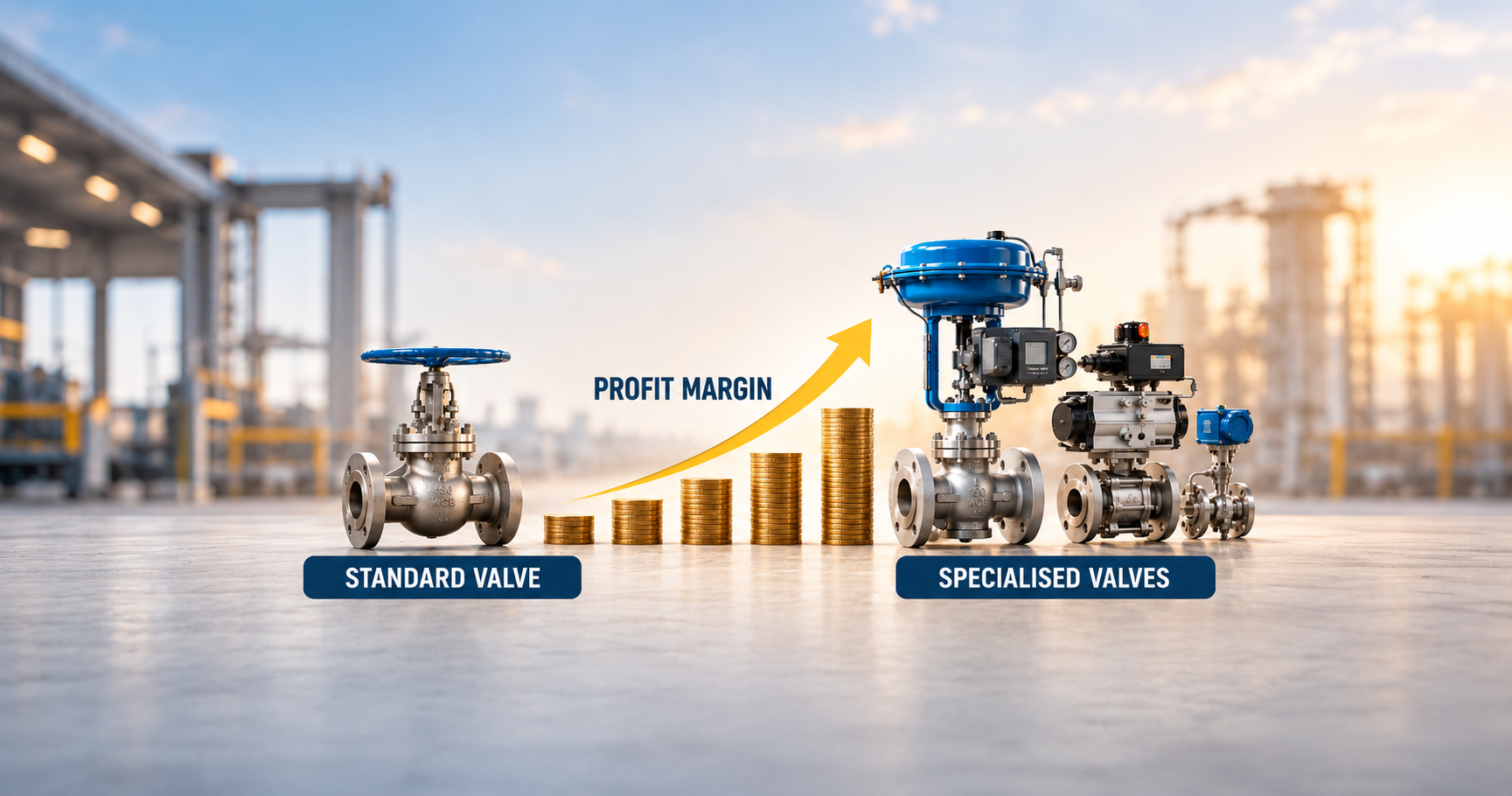
Where Does the Profit Actually Move?
This is the central question of the entire industry.
Imagine the industrial-valve value chain as a ladder.
LEVEL 1
Standard valve
Competition is heavily influenced by price.
↓
LEVEL 2
Tested valve
The manufacturer demonstrates repeatable quality.
↓
LEVEL 3
Certified / specification-compliant valve
The supplier can access customers with defined qualification requirements.
↓
LEVEL 4
Actuated valve
Valve + actuator + integration.
↓
LEVEL 5
Engineered valve package
Valve + actuator + positioner/control + testing + documentation + commissioning.
↓
LEVEL 6
Specialised valve
Severe service, difficult media, high pressure, high temperature or application-specific requirements.
↓
LEVEL 7
Lifecycle supplier
Spares + maintenance + retrofit + service.
The manufacturer does not have to reach Level 7.
The important question is:
What is the next level your factory can realistically reach?
The Actuation Opportunity
One of the most practical routes for an existing valve manufacturer is actuation.
Instead of selling:
valve
the company can supply:
valve + actuator + positioner + commissioning.
This changes the value of the order.
It also creates the possibility of service revenue through:
- calibration;
- preventive maintenance;
- actuator replacement;
- retrofit;
- troubleshooting;
- spare parts.
For an MSME, this may be a more realistic route to value addition than trying to develop an entirely new valve technology.
The important word is integration.
The manufacturer does not necessarily have to build the actuator.
It can build the valve and develop reliable partnerships for the rest of the package.
Specialisation: The More Difficult the Application, the Better the Question
A standard valve manufacturer may ask:
“How many competitors do I have?”
An application specialist should ask:
“How many competitors can actually satisfy this specification?”
That is a completely different competitive equation.
Consider:
General industrial valve
Large customer base.
Large competitor base.
Price-sensitive.
Chemical-service valve
More material expertise.
Fewer capable suppliers.
Severe-service valve
Higher engineering requirement.
More specialised metallurgy.
Certified pipeline valve
Qualification barrier.
Hydrogen-service valve
Emerging specifications.
Customer qualification.
Potential early-mover opportunity.
The profit opportunity does not automatically rise with technical complexity.
But the basis of competition changes.
And that is what matters.
What Should a ₹5–25-Crore MSME Do?
The original research correctly identified a practical problem.
An MSME cannot invest in everything.
A manufacturer with a ₹5-crore business cannot simply copy the investment strategy of a ₹500-crore valve company.
So the first step should be an audit.
Ask five questions:
1. Which three industrial-valve products generate most of our revenue?
2. How much of our business is won primarily on price?
3. Which industrial sectors already buy from us?
4. What specification prevents us from entering the next customer category?
5. What is the smallest investment required to remove that barrier?
That last question is crucial.
It may be:
- better testing;
- material verification;
- CNC capability;
- documentation;
- quality systems;
- certification;
- actuation;
- engineering manpower;
- or a new material capability.
Don’t Buy the Machine Before Finding the Customer
This may be the most important advice for an MSME.
The wrong sequence is:
Machine → product → hope for orders.
The better sequence is:
Customer → application → specification → qualification → capability gap → investment → production.
This is particularly important for emerging markets such as hydrogen.
A manufacturer should first determine:
Who is buying?
What valve are they specifying?
What standard applies?
Who are the approved suppliers?
What is the qualification process?
How long is the sales cycle?
What investment is required?
Only then should the machine purchase be considered.
The Testing Investment
The original research estimated:
- Hydrostatic testing equipment: ₹15–25 lakh
- Material-analysis equipment: ₹8–12 lakh
- Certification and quality-system expenditure: additional investment depending on the target market
- Broader upgrade requirement: approximately ₹25–50 lakh
These should not be treated as universal industry prices.
Equipment cost depends on pressure range, size, automation, manufacturer and configuration.
Certification cost similarly varies with scope and product.
But the larger point remains valid:
An MSME may need to spend tens of lakhs not to make more valves, but to become eligible to sell a different class of valve.
That is a very different capital-allocation decision.
Shared Infrastructure Could Change the Equation
Every MSME does not necessarily need to own every piece of equipment.
Cluster-level facilities can potentially support:
- testing;
- material analysis;
- calibration;
- inspection;
- training;
- common procurement.
That can make upgrading more feasible for smaller units.
The DCMSME’s own work on the metallic-valve manufacturing ecosystem highlights the importance of domestic capability and the scope for higher-value manufacturing and exports. DCMSME
For Ahmedabad and Rajkot in particular, the cluster model deserves serious attention.
The question should not always be:
“Can my factory afford this equipment?”
It can also be:
“Can five factories share the capability?”
Case Study: Hawa — Certification and Global Markets
Hawa’s present business profile provides a useful example of the certification route.
The company says it manufactures valves for oil & gas upstream and downstream, petrochemical, power, pipeline, marine and general industrial applications, with exports to more than 40 countries.
Its certification portfolio includes API 6D, API 6A, API 6DSS, API 609 and API 594, along with ISO 9001, CE/PED, ATEX and SIL certifications. Hawavalves
The lesson:
Certification is not the destination. It is the passport to a customer segment.
Case Study: Microfinish — Specialisation
Microfinish provides another route.
Its current product portfolio includes ball valves, bellows-sealed globe valves, gate, globe and check valves, pneumatic actuators and automated units. The company also has API 6D, PED, ATEX and SIL certifications. Microfinish Group
Its nuclear business includes bellows-seal globe valves up to ASME Class 2500, including manual and automated configurations. Its refining portfolio includes metal-seated valves for severe-service applications, with products available up to Class 2500 and temperatures up to approximately 650°C. Microfinish Group
The important lesson is not the company’s exact financial performance.
It is the strategy:
Specialisation can create a moat.
A manufacturer does not necessarily need the largest catalogue.
It can become extremely good at a difficult application.
The Three Routes Up the Value Chain
The Indian industrial-valve MSME essentially has three broad strategic choices.
ROUTE 1: VOLUME
Make conventional valves efficiently.
Win through:
- cost;
- delivery;
- quality;
- distribution;
- working capital.
This can remain a viable business.
But price competition remains high.
ROUTE 2: SPECIALISATION
Choose a sector.
For example:
oil & gas
chemical
water
power
severe service
Develop the specification and qualification expertise required by that sector.
ROUTE 3: INTEGRATION
Move from:
valve
to:
valve + actuator + controls + service.
The company becomes a flow-control solution provider rather than simply a component manufacturer.
What Happens to the ₹6,500 Crore?
This is the question every manufacturer should eventually ask.
The projected market expansion from approximately:
₹12,948 crore (US$1.56 billion)
to:
₹19,422 crore (US$2.34 billion)
does not mean every existing manufacturer will grow by the same 50%.
It means the market itself is expanding.
The additional ₹6,474 crore (US$780 million) will be competed for across:
- oil & gas;
- water;
- petrochemicals;
- chemicals;
- power;
- infrastructure;
- automation;
- replacement;
- EPC projects;
- exports;
- engineered products;
- emerging applications. Mordor Intelligence
The winners will not necessarily be the companies with the biggest installed capacity.
They may be the companies that identify where the specification, qualification and customer demand are moving before competitors do.
A 12-Month MSME Road Map
The original research proposed a 12-month transition plan. The concept remains useful, but the sequence should be more customer-led.
MONTHS 1–2
Audit
Map:
- current products;
- customers;
- margins;
- rejection rates;
- testing capability;
- certifications;
- capacity;
- working capital.
Identify the three most profitable existing products rather than simply the three highest-volume products.
MONTHS 3–4
Choose One Target Market
Do not chase oil & gas, water, chemicals, power and hydrogen simultaneously.
Choose one.
Ask:
Where do our existing capabilities give us the shortest distance to qualification?
MONTHS 5–6
Close the Capability Gap
Invest only in what the selected market requires.
Possibilities:
- testing;
- material verification;
- machining;
- quality systems;
- documentation;
- engineering;
- actuation.
MONTHS 7–8
Develop the Product
Build a defined product/application package.
Not:
“We manufacture industrial valves.”
But:
“We manufacture this valve, for this application, to this specification.”
That is a much stronger proposition.
MONTHS 9–10
Customer Qualification
Approach:
- EPC companies;
- Tier-1 manufacturers;
- utilities;
- industrial plants;
- approved-vendor programmes;
- system integrators.
The target should be qualification and trial orders, not merely enquiries.
MONTHS 11–12
Scale What Has Been Accepted
Only after customer validation should the manufacturer expand capacity.
That protects capital.
The Biggest Mistake Would Be Chasing “Smart Valves”
There is a tendency to assume that the future automatically means IoT.
It doesn’t.
For an industrial-valve MSME, the first step may simply be:
better valve
then:
better testing
then:
better documentation
then:
certified valve
then:
actuation
then:
remote monitoring.
Digital capability is valuable.
But digitalisation cannot compensate for a valve that fails mechanically.
The foundation remains:
design + materials + manufacturing + testing + reliability.
The Real Profit Equation
The industrial-valve business can increasingly be viewed as:
Valve + Specification + Testing + Certification + Application Knowledge + Service
The more elements a manufacturer can reliably provide, the less the product resembles a commodity.
That does not mean every valve becomes a high-margin product.
It means the manufacturer gains more opportunities to differentiate the offer.
And differentiation is ultimately what protects margins.
So, Which Valves Make Profit?
There is no universal answer.
But the direction is becoming clearer.
Ball valves
The largest product pool at 25.17% market share.
Butterfly valves
A major industrial category growing at approximately 7.05% CAGR, with higher-performance designs offering opportunities for engineering differentiation.
Oil & gas valves
The largest application pool at 35.20%.
Water and wastewater valves
An application growing at approximately 7.08% CAGR, with large infrastructure-driven demand.
Chemical-service valves
An opportunity where material and application knowledge can matter more than the lowest price.
Actuated and control solutions
An avenue to move from a component to an integrated flow-control package.
Specialised/severe-service valves
Smaller addressable markets, but potentially higher barriers to entry.
Hydrogen-service valves
An emerging opportunity where India is building a new industrial ecosystem — but one that requires patience, qualification and technical capability.
The Verdict: Follow the Money — But Follow the Specification First
India’s industrial-valve market could grow by approximately:
₹6,474 crore (US$780 million)
between 2025 and 2031.
Oil & gas remains the largest application.
Ball valves remain the largest product category.
Water and wastewater is growing.
Chemical and power applications offer specification-driven opportunities.
And Green Hydrogen could become the next important industrial station as India’s hydrogen infrastructure develops.
But the biggest lesson for an MSME is not:
“Move into high-margin valves.”
It is:
Move into the next level of capability your customer is willing to pay for.
For one manufacturer, that may be better testing.
For another, API-qualified pipeline valves.
For another, double-offset or triple-offset butterfly valves.
For another, chemical-service materials.
For another, actuation.
For another, severe-service applications.
And for a few technically capable early movers, hydrogen-service valves may eventually become a new opportunity.
The market is not asking every manufacturer to become a giant.
It is asking manufacturers to become harder to replace.
The next six years could add roughly ₹6,500 crore to India’s industrial-valve market.
The question for every MSME is therefore no longer simply:
“How many valves can we make?”
It is:
“Which valves can we make that the customer cannot buy from just anybody?”
Sources & Credits
Market size, growth and segmentation
- Mordor Intelligence — India Industrial Valves Market, 2026–2031: market size, CAGR, ball-valve share, quarter-turn share, oil & gas share, butterfly-valve growth and water/wastewater growth. Mordor Intelligence
- Mordor Intelligence — Global Butterfly Valve Market: high-performance, double-offset, triple-offset and application trends. Mordor Intelligence
Green Hydrogen
- Ministry of New and Renewable Energy — National Green Hydrogen Mission: 5 MMT annual production target and mission framework. Ministry of New and Renewable Energy
- Government of India / National Green Hydrogen Mission — Mission approval and financial outlay of ₹19,744 crore (US$2.38 billion) and associated investment target. Ministry of New and Renewable Energy
- National Green Hydrogen Mission — SIGHT programme and awarded electrolyser/green-hydrogen capacities. Ministry of New and Renewable Energy
Industrial standards and technical requirements
- American Petroleum Institute — API Specification 6D, Specification for Valves. American Petroleum Institute
- American Petroleum Institute — API 6D Addendum 2, including provisions addressing hydrogen-gas-service requirements. American Petroleum Institute
- ASME — B16.34, Valves — Flanged, Threaded, and Welding End: pressure-temperature ratings, dimensions, materials, testing, marking and related requirements. ASME
Natural gas infrastructure
- Petroleum and Natural Gas Regulatory Board — Natural Gas Pipeline Network data: approximately 34,238 km authorised and 25,923 km operational as of September 2025. PNGRB
- PNGRB — March 2025 Natural Gas Pipeline Network report. PNGRB
MSME / domestic manufacturing
- Office of the Development Commissioner, Ministry of MSME — Report of Domestic Manufacturing of Metallic Valves / Items Having Higher Import & Scope of Export. DCMSME
Company examples
- Hawa Valves — corporate overview and certifications, including exports to 40+ countries and API/ISO/CE/PED/ATEX/SIL credentials. Hawavalves
- Microfinish Valves — company profile, certifications and nuclear/refining applications. Microfinish Group
Exchange-rate convention
- INR conversions in this article use ₹83 = US$1, consistent with the exchange-rate baseline specified in the original research draft. Where market sources report US dollars, the corresponding INR figure is therefore an indicative conversion rather than a current





Leave a Reply