
MSME Briefing Bureau
The Ambani split shows why succession must be settled before a family crisis begins
A Fortune Built, a Question Left Behind
Dhirubhai Ambani spent decades building one of India’s most formidable business empires. But when he died in July 2002 without leaving a will, one critical question remained unresolved: who would control what?
The answer would emerge only after a bitter struggle between his sons, Mukesh and Anil Ambani.
For family-run MSMEs, the story is not really about two billionaire brothers. It is about something far closer to home: what happens when a founder builds the business but does not build the succession system?
When Family Uncertainty Becomes Business Risk
After Dhirubhai’s death, Mukesh and Anil continued within the Reliance structure. But disagreements over authority and control eventually moved beyond the family.
The conflict became public.
At one point, Anil declined to approve Reliance’s financial statements, citing inadequate disclosures. What had begun as a succession problem was turning into a corporate governance problem.
What makes the episode particularly instructive is that the underlying business was hardly collapsing.
For FY2004–05, Reliance Industries reported a net profit of ₹7,572 crore, up 47%, on turnover of ₹73,164 crore. Operationally, the company was producing exceptional numbers.
Yet above those numbers hung a fundamental uncertainty: who was ultimately in charge?
That distinction matters enormously for family businesses.
A company can have healthy orders, strong cash flows and valuable assets—and still become vulnerable when ownership, authority and succession are unclear.
Good financial performance cannot permanently compensate for poor governance.
The Moment the Market Chose Certainty
By 2005, the dispute required intervention from within the family.
Their mother, Kokilaben Ambani, mediated a settlement announced on 18 June 2005.
Mukesh assumed responsibility for Reliance Industries and IPCL, while Anil took responsibility for Reliance Infocomm, Reliance Energy and Reliance Capital. The restructuring subsequently led to the demerger of businesses.
Then something revealing happened.
When markets reopened after the settlement, Reliance Industries shares jumped 7.5%, while India’s benchmark stock index crossed 7,000 for the first time. Reliance Energy surged 19% and Reliance Capital 30%.
The market was not simply applauding a family settlement.
It was pricing the return of certainty.
That may be the most useful lesson for an MSME founder.
Employees, bankers, suppliers, customers and investors can tolerate many business difficulties. What they struggle to price is uncertainty about who controls the company and who can make the final decision.
And even the 2005 settlement did not eliminate every dispute. Differences over natural gas subsequently reached the Supreme Court, demonstrating how unresolved commercial obligations can survive a family separation.
Four Rules Every Family Business Needs
The Ambani episode offers a practical roadmap for family-run enterprises.
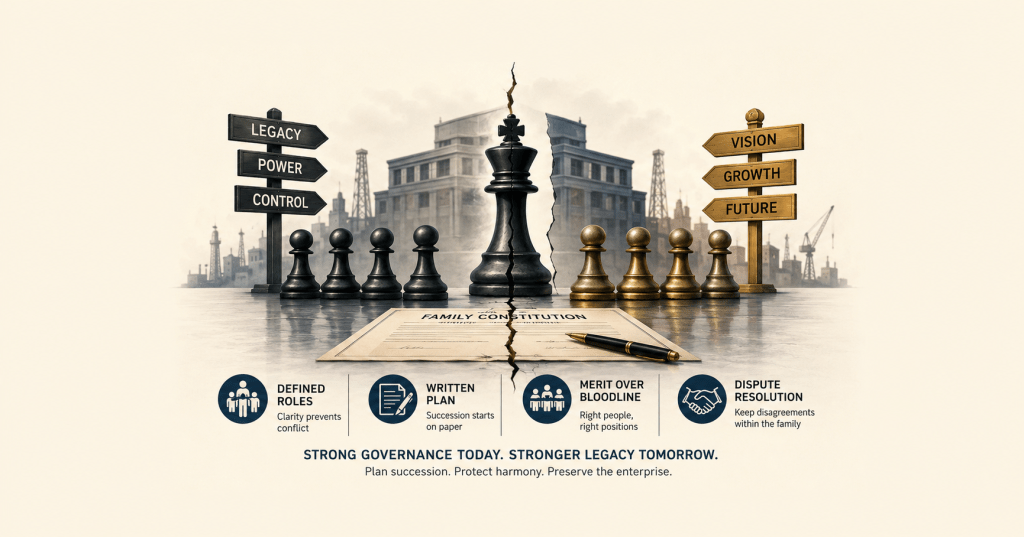
1. Move from “family business” to “business family”.
Family relationships matter, but business decisions require defined roles. At work, a brother, daughter or son must have authority based on responsibility, not merely family position.
2. Write succession before you need succession.
Do not leave the next generation to interpret the founder’s intentions. Document ownership, voting rights, leadership succession, board representation and exit mechanisms while relationships are healthy.
3. Separate ownership from management.
Being an heir does not automatically make someone the best CEO. Family members can remain owners while qualified professionals manage operations. Equity is inheritance; executive authority should be earned.
4. Create a mechanism for disagreement.
Every family eventually disagrees. The question is whether the dispute is resolved around a table or allowed to reach employees, customers, lenders and courts.
A family constitution, shareholders’ agreement, independent advisory board or agreed mediation mechanism can provide that firebreak.
Your Succession Clock Is Already Running
Founders often treat succession as something to discuss after retirement.
That is dangerous.
Succession planning is not about preparing for death. It is about ensuring that the enterprise can make decisions without depending upon one individual.
Ask four questions today:
Who owns the business? Who runs it? Who succeeds the founder? And what happens when family members disagree?
If those answers exist only in the founder’s mind, the business does not yet have a succession plan.
The Ambani story shows that even an extraordinarily successful enterprise can face uncertainty when legacy is clearer than succession.
For an MSME founder, the objective should therefore be simple:
Do not merely leave your children a business. Leave them a system capable of protecting it.
Next in Family Business
In our next episode, MSME Briefing examines the Murugappa Group governance dispute—and what family enterprises can learn about family constitutions, gender, ownership rights and institutional governance when tradition collides with the claims of the next generation.
Have you seen a family business successfully manage succession—or watched one struggle because roles were never defined?
Share the story with MSME Briefing at connect@msmebriefing.com. Your experience could help another founder protect what took decades to build.





 MSME Briefing
Leave a comment